
A Functional Data Space Hierarchy
Why Structure Matters: Products, Domains, and Trustworthy Digital Cooperation
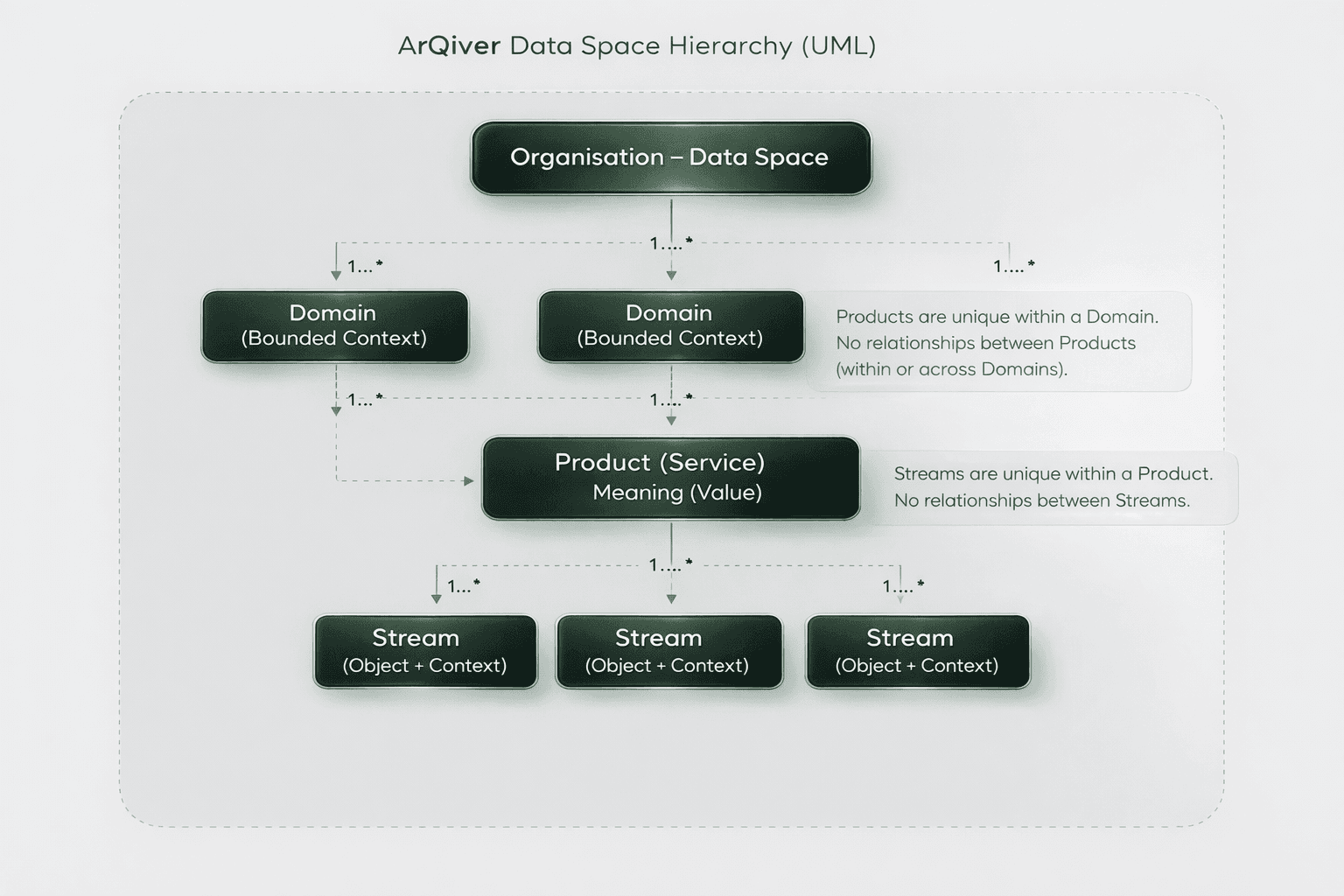
In modern digital systems, data moves easily—but meaning does not. Without clear structure, organisations risk losing context, accountability, and trust. The diagram presented here visualises a deliberate architectural choice that addresses this challenge by grounding digital cooperation in clear, lawful, and interpretable structures. It shows how organisation, domain, product, and stream form a hierarchy that preserves meaning while enabling collaboration at scale.
Products as the Atomic Unit of Cooperation
At the heart of the diagram lies the product. A product is not a static artifact, but a living boundary of meaning. It unites purpose (what is being done) with form (how it is governed and recorded). Within a data space, the product is the smallest unit that is simultaneously legal, semantic, and operational. It is where law, process, and information converge.
Because a product is contextually and legally bounded, it allows humans and AI systems to act together responsibly. Automation, decision support, and AI execution remain explainable and compliant precisely because they operate within a clearly defined product boundary. In this sense, the product is the atomic unit of responsible digital cooperation.
The Role of Domains as Bounded Contexts
Products do not exist in isolation. Each product belongs to exactly one domain, which functions as a bounded context. A domain defines shared language, rules, and interpretation. Inside a domain, meaning is coherent; across domains, translation must be deliberate and explicit.
This separation is critical. When products or data cross domains without structure, meaning erodes and decisions become unreliable. By ensuring that products are unique within a domain—and that there are no implicit relationships between products—the architecture preserves semantic integrity and legal clarity.
Organisation as Governance Boundary
The organisation forms the outer boundary. It provides identity, governance, and accountability. It defines purpose and permission: what the organisation aims to achieve and what it is legally allowed to do. Domains and products derive their legitimacy from this organisational boundary, ensuring that every action can be explained, audited, and defended.
This structure enables enterprises to act responsibly in society—not merely by producing outcomes, but by doing so lawfully, ethically, and transparently.
Streams as Controlled Execution
Within each product, one or more streams represent execution: processes, decisions, transactions, or events. Streams are unique within a product and have no relationships with each other beyond that shared product context. This is intentional. Streams carry out actions, but they do not interpret meaning independently. Meaning remains anchored at the product level.
This separation ensures traceability and prevents unintended coupling. It allows systems to scale while remaining understandable and auditable.
Why This Structure Enables Trust
Together, organisation, domain, product, and stream form three concentric boundaries that preserve context and meaning. They ensure that data remains purpose-bound, that collaboration is lawful, and that every participant—human or AI—operates from the same verified understanding.
This is the foundation of a trustworthy, federated data economy: not more data sharing, but better structure. Not centralisation, but context. When structure is right, complexity becomes manageable, innovation becomes safe, and trust becomes systemic rather than accidental.